0 Items - £0.00
- No products in the cart.

Kindness doesn’t usually arrive with a big announcement.
It shows up quietly — in small choices, in noticing someone else, in moments that are easy to miss.
For many children, those moments first appear in stories.
Not because a book tells them to be kind, but because it lets them see kindness happening. A character waits. Shares. Listens. Makes a mistake and tries again. And slowly, almost without effort, children begin to understand what kindness looks like in real life.
Children feel deeply, but they don’t always know what to do with those feelings. Stories help.
When a character feels left out, worried, or unsure, children recognise something familiar. They might not say it out loud, but they feel it. And when that character is treated with care — or learns to show care themselves — children begin to make quiet connections.
That’s how it feels.
That’s what helps.
These moments matter more than we often realise.
One of the loveliest things about stories is that they don’t tell children what to think. They don’t spell out lessons or demand the “right” response.
Instead, they let children watch.
They notice how a kind action changes the mood of a story. They see how words can hurt or heal. They observe what happens when someone is patient, or brave, or gentle.
Because the lesson isn’t forced, it tends to stay.
The kindness children see in books is often ordinary — and that’s why it works.
A shared toy. A moment of understanding. Someone choosing to help when it would be easier not to.
These are things children recognise from their own lives. They don’t feel impossible or abstract. They feel doable.
And that makes all the difference.
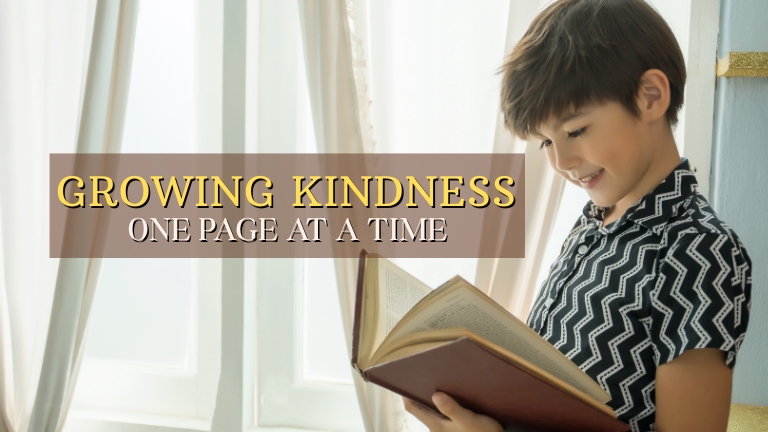
When you read with a child, something else happens alongside the story. There’s room to pause. To wonder. To ask a quiet question.
Sometimes children will comment on what they’ve noticed. Other times, they won’t say anything at all. Both are fine.
Kindness often grows in the background, without needing to be named.
Children often return to the same books again and again. And each time, they bring something new with them — a bit more understanding, a bit more awareness.
What felt like a simple story the first time can feel different later on. Deeper. More familiar. More personal.
That’s how kindness settles in. Slowly. Repeatedly. Gently.
Stories don’t raise kind children on their own. But they do something important. They give children examples to return to. Feelings to recognise. Moments to hold onto.
And page by page, they help kindness grow — quietly, naturally, in its own time.
Lorem ipsum dolor sit amet, consectetur adipiscing elit, sed do eiusmod tempor incididunt ut labore et dolore magna aliqua. Ut enim ad minim veniam, quis nostrud exercitation ullamco laboris nisi ut aliquip ex ea commodo consequat. Duis aute irure dolor in reprehenderit in voluptate velit esse cillum dolore eu fugiat nulla pariatur. Excepteur sint occaecat cupidatat non proident, sunt in culpa qui officia deserunt mollit anim id est laborum.
Meet Harry, the creative force behind our new children’s book. With a strong foundation in the world of theatre, Harry has dedicated years to crafting stories that inspire joy and self-belief. Now, he’s bringing his unique perspective to children’s literature.